1994 began with the NASA’s Beowulf project . Instead of expensive specialized hardware, Beowulf used off-the-shelf PCs, connected them via a network, and had them perform computations together.
This innovation heralded a new era in high-performance computing: HPCwas no longer the domain of the big players. The new concept made it affordable for universities, private research institutions and smaller companies.
It is a milestone in our company history that we became a partner to numerous scientific institutions in the 2000s with our highly efficient and individually scalable HPC platforms and our many years of experience in the field of Linux and networking.
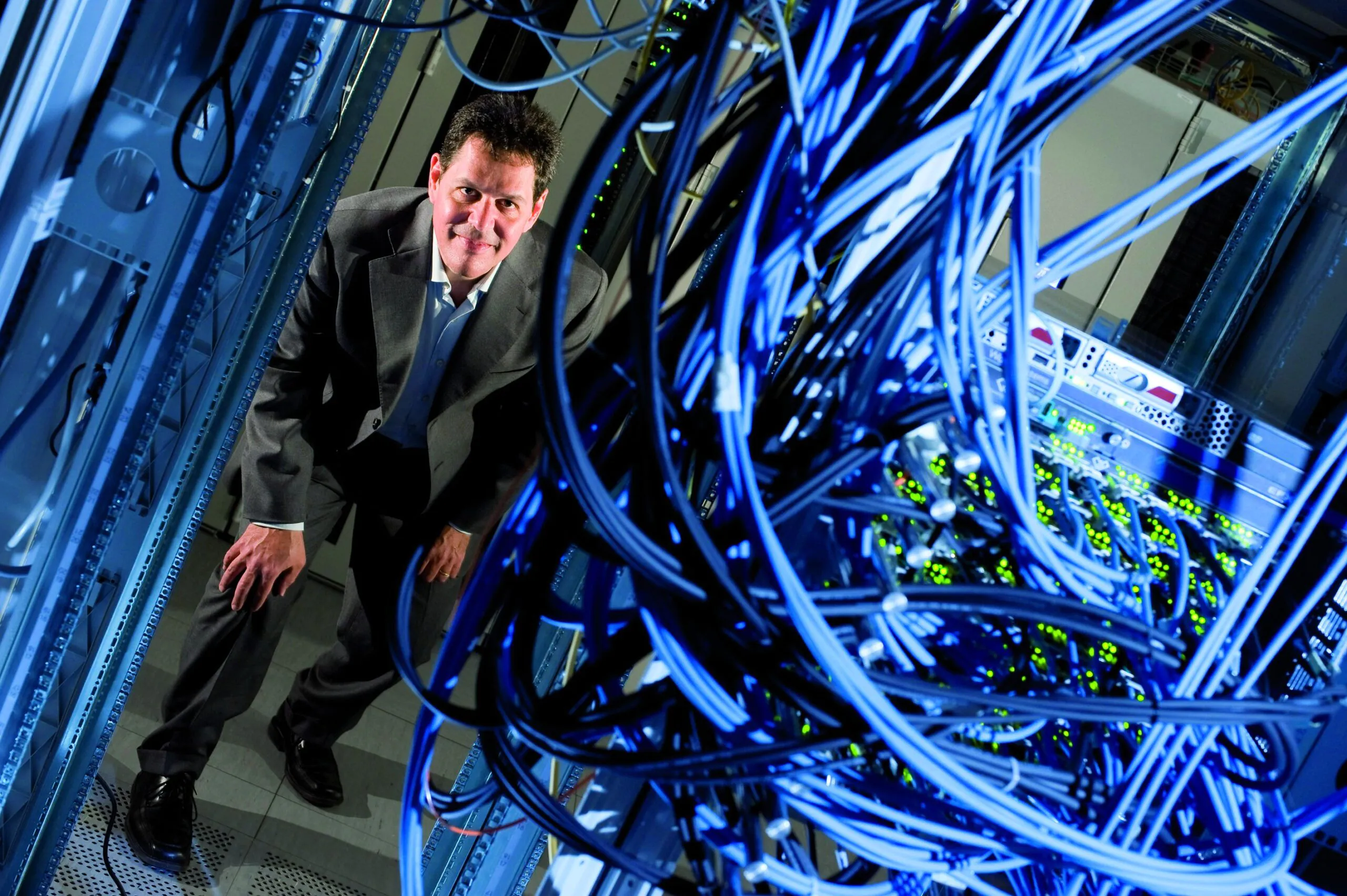
One of the customers that made use of our expertise was the Max Planck Institute for Gravitational Physics (Albert Einstein Institute) in Hanover. The ATLAS cluster went into operation there in May 2008. In it, Pyramid's expertise combined 1400 computers with 5684 CPU cores and 1 pentabyte of storage to create a supercomputer that was one of the 40 fastest in the world at the time. The picture shows Prof. Dr. Bruce Allen, under whose leadership the project was created, and a network switch from ATLAS.
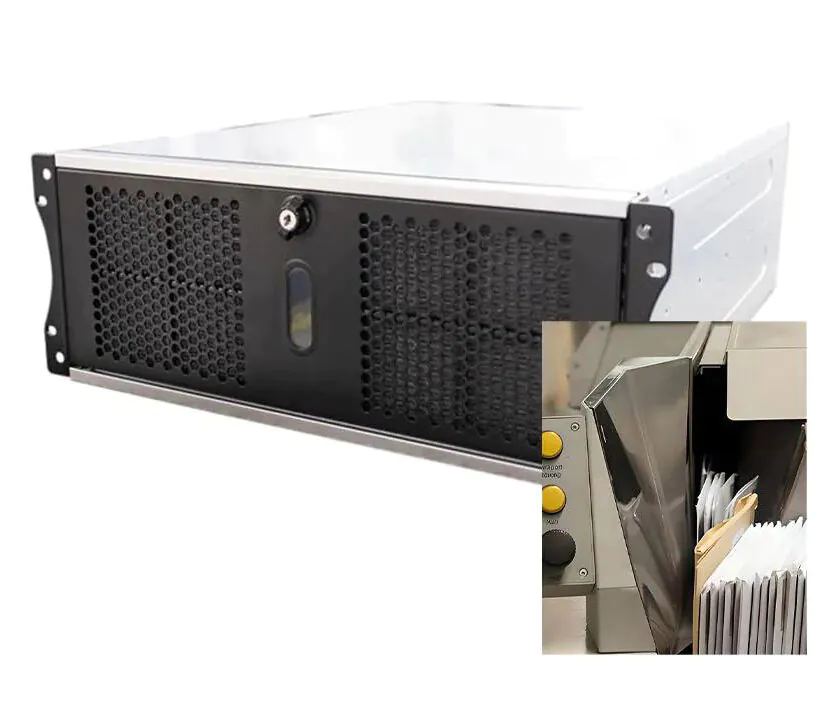
We have also had and continue to have customers from research and science beyond HPC. We currently support partners from the precision mechanics and optics industry and medical technology with industrial PCs and servers from the AKHET® and touch PCs of the faytech®. These are generally OEM and ODM solutions.
AKHET® controls scanning electron microscopes in industry, high content screening platforms in life science research and laboratory machines for pre- and post-analytical procedures in hospitals. Touch PCs from faytech® enable precise image recording and live streaming in HD resolution in endoscopy.
Here you will find more about the exciting 40 years of Pyramid!